

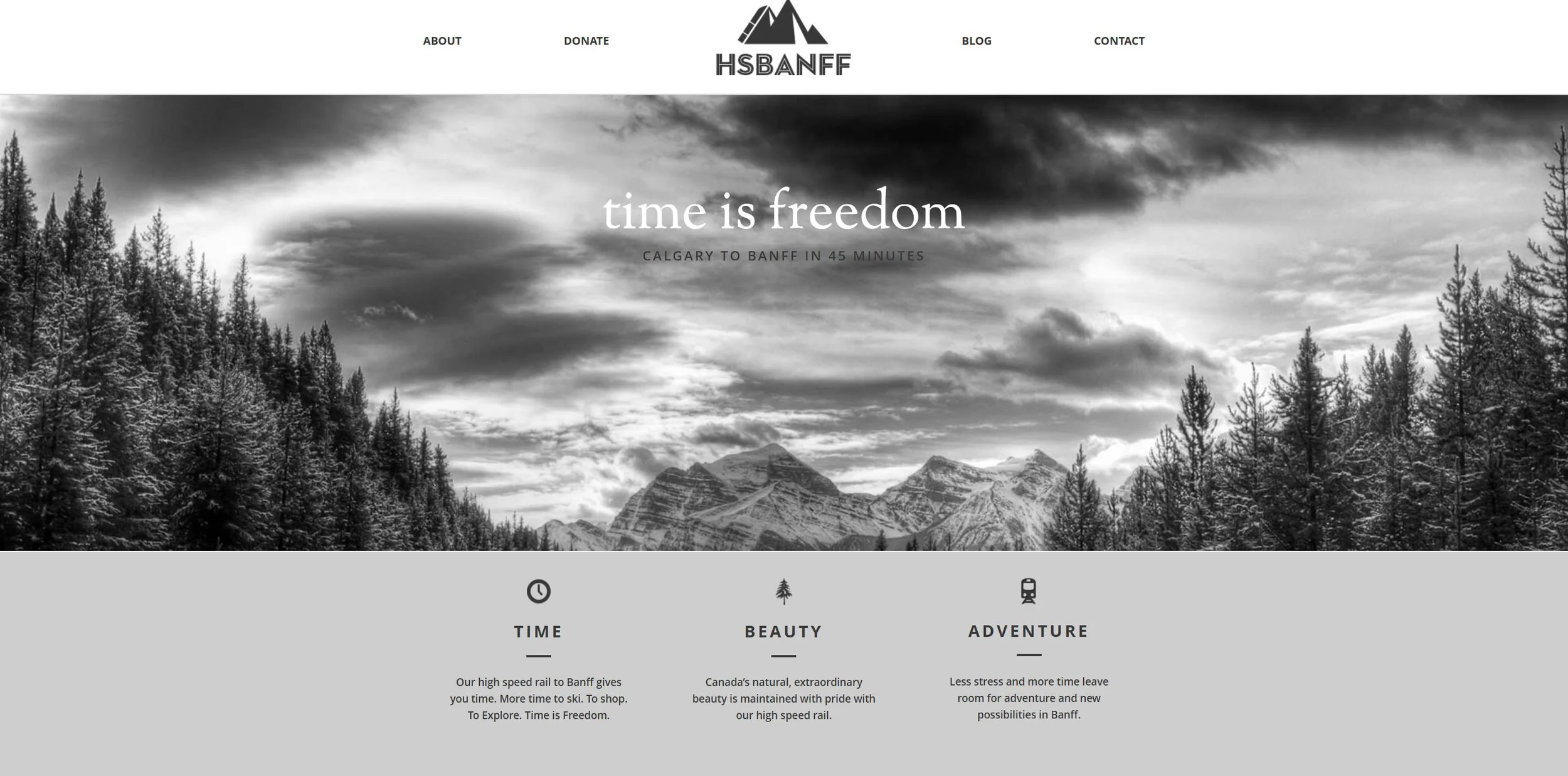
HSBanff — High-Speed Rail from Calgary International Airport to Banff
Intermodal Transportation, Infrastructure Strategy & Sustainable Mobility
Founded by Greg Dansereau in 2014
Opening
In 2014, I founded HSBanff, a private not-for-profit initiative proposing high-speed passenger rail connecting Calgary International Airport with Banff National Park.
The concept approached travel to Banff as an integrated transportation system rather than a series of disconnected modes. International passengers arriving at Calgary International Airport would be able to transfer directly from aviation to rail, with an operational objective of eventually supporting a single air-rail ticket for travelers continuing to Banff.
The public proposal contemplated high-speed rail technology capable of speeds of up to 400 km/h, frequent service, an approximately 45-minute journey, and an alternative to the growing dependence on private vehicles for access to Banff.
At its centre was a simple question:
Could we make Banff easier to reach while reducing the transportation pressures on the place people were travelling there to experience?
HSBanff became an early exploration of how aviation, rail, tourism, environmental stewardship, infrastructure, governance and community participation might be considered as parts of a single transportation system.
The Origin of the Idea
Banff had been important to me for years.
After spending considerable time away, I returned and was struck by what growing automobile traffic was doing to the experience of the park. The contradiction was difficult to ignore: people travelled enormous distances to experience one of Canada's extraordinary natural environments, while the transportation system carrying them there was contributing to congestion and pressure on that environment.
The problem did not appear to me to begin at Banff's boundary.
Many visitors began their journey much earlier—often on an aircraft arriving at Calgary International Airport. From there, the transportation system effectively fragmented. The traveler moved from aviation into ground transportation, onto regional highways, through Bow Valley communities and eventually into the national park.
Administratively, these could be understood as separate systems.
For the traveler, they were one journey.
That became the starting point for HSBanff.
The Concept
HSBanff's mission was publicly described in May 2014 as becoming Canada's first high-speed rail service connecting Calgary International Airport to Banff National Park. The proposal included an intermodal connection allowing arriving airline passengers to transfer to high-speed rail and contemplated a single air-rail ticket for international visitors.
The concept brought together several elements:
high-speed passenger rail between Calgary and Banff;
direct connectivity with Calgary International Airport;
integration of aviation and rail within the passenger journey;
seamless transfer between flight and train;
a longer-term objective of integrated air-rail ticketing;
approximately 45-minute travel between Calgary and Banff;
frequent service;
reduced dependence on private automobiles;
protection of Banff's natural environment;
public and community participation;
alternative approaches to early-stage infrastructure financing; and
governance involving multiple stakeholders.
The proposed technology was capable of operating at speeds of up to 400 km/h. This represented a conceptual and feasibility-stage proposition: engineering, environmental assessment, route selection, regulatory approval and financing would all have been required before construction.
The System Boundary Was the Journey
What distinguished HSBanff was not the idea of passenger rail to Banff.
Rail had historically served Banff, and ideas for restoring passenger rail between Calgary and the Bow Valley existed independently.
HSBanff began with a different system boundary:
the traveler's journey from Calgary International Airport to Banff National Park.
The airport was therefore not an extension that might eventually be added to a Calgary–Banff railway.
It was the starting point of the concept.
That changed the problem.
Instead of asking only:
How could passenger rail operate between Calgary and Banff?
HSBanff also asked:
How could an international visitor move from aircraft to railway to national park as part of a coherent passenger journey?
That required looking across boundaries between aviation, rail, highways, tourism, communities, environmental stewardship and infrastructure governance.
Looking back through the lens of my current work, I can see HSBanff as an early example of a recurring orientation in how I approach complex systems:
The boundaries of an institution are not necessarily the boundaries of the problem.
Access and Environmental Stewardship
Environmental protection was part of the public rationale from the project's beginning.
The May 2014 launch described high-speed rail not simply as transportation infrastructure but as a potential alternative for people travelling to Banff that could contribute to protecting the national park's ecosystem.
This created an important tension.
Banff exists to be experienced.
But greater access can itself create pressure on the place being accessed.
HSBanff therefore explored whether transportation infrastructure could improve access while simultaneously reducing some of the environmental and congestion consequences associated with automobile dependence.
The question was not simply whether a train could be built.
It was whether access and stewardship could be designed together.
Challenging the Existing Frame
HSBanff also encountered many of the familiar objections surrounding passenger and high-speed rail in Canada.
Questions included:
Would enough people use it?
Could high-speed rail be financially viable?
Was Canada's population sufficiently dense?
Would travelers still require automobiles at their destination?
How should the cost of rail be compared with highways?
What environmental benefits should be included?
What are the social and economic costs of the transportation system already in place?
How should changing travel preferences affect long-term infrastructure planning?
The project responded publicly to these questions through its Just the Facts material.
The important shift was one of comparison.
A proposed transportation system should not be evaluated against an imaginary condition in which the existing system has no cost.
Road infrastructure has costs.
Congestion has costs.
Collisions have costs.
Land use has consequences.
Vehicle emissions have consequences.
Infrastructure choices influence behaviour.
The more useful question therefore becomes:
What are the comparative costs, benefits and consequences of the transportation architecture we already have and the alternatives we might create?
That systems framing would become increasingly familiar in my later operational, governance and research work.
Testing Interest Before Building
HSBanff proposed using crowdfunding to finance early feasibility and environmental work.
But crowdfunding also served another purpose.
It provided a way to test whether the public was sufficiently interested in the proposition to participate in its development.
As I said in the 2014 launch announcement:
“We won't build if people don't want to ride.”
The release connected crowdfunding and social media directly with two early project questions: ridership and community involvement.
In contemporary language, I would recognize this as a form of human-system feedback: introducing a proposition into the environment and observing how the people who would ultimately interact with the system responded to it.
That terminology was not part of HSBanff in 2014. The underlying concern was.
Governance and Participation
HSBanff was established as a private not-for-profit undertaking, rather than simply as a commercial railway proposition. The public launch described its purpose as demonstrating the feasibility of high-speed rail as a transportation alternative in Canada while supporting protection of natural habitat in Banff.
The proposed organizational architecture contemplated participation from government, business, independent directors, communities and stakeholders.
This reflected another aspect of the problem.
Major infrastructure is never only an engineering problem.
It intersects with:
operations
financing
regulation
environment
communities
public legitimacy
governance
technology
human behaviour
A technically viable solution can still fail if those systems cannot be brought into workable alignment.
Public Engagement
HSBanff was publicly launched on May 16, 2014, through a national CNW news release announcing plans to design, construct and operate high-speed rail between Calgary and Banff National Park. The release identified me as the project's founder.
The proposal subsequently generated media interviews, community discussions and public debate around the feasibility and desirability of high-speed passenger rail to Banff.
One of the earliest appearances was a CBC television interview around the time of the launch. I have not been able to locate a surviving public archive of that broadcast, so it is not relied upon here as documentary evidence.
Other surviving media and project records will be added to this archive as they are recovered and catalogued.
What Happened Next
HSBanff did not proceed through feasibility into construction, and the organization eventually ceased operating.
I have had no involvement in the Calgary–Banff passenger rail initiatives that followed HSBanff, and I make no claim that those projects originated from or were influenced by my work.
The chronology is nevertheless noteworthy.
HSBanff publicly proposed high-speed passenger rail connecting Calgary International Airport with Banff National Park in May 2014.
Later Calgary–Banff rail proponents describe their own contemporary initiative as emerging afterward. Friends of Calgary Airport–Banff Rail describes a later concept-development process beginning in the following years and ultimately expanding into direct rail between Calgary Airport, downtown Calgary and Banff.
An independent Canadian high-speed-rail publication subsequently included HSBanff when recounting the history of renewed Calgary–Banff passenger-rail proposals in 2020.
The Question Remains Open
The project ended.
The transportation question did not.
In the years following HSBanff, municipal governments, the Province of Alberta, the Canada Infrastructure Bank and private-sector proponents undertook increasingly substantial work examining passenger rail between Calgary and Banff.
The Canada Infrastructure Bank describes the contemporary proposition as a roughly 130-kilometre passenger railway connecting Calgary International Airport and Banff, with intermediate connections and objectives including tourism, labour mobility, congestion reduction and lower greenhouse-gas emissions.
Alberta's Major Projects inventory separately identifies the Calgary–Banff Rail Link as a proposed multibillion-dollar project involving Calgary International Airport and Banff.
And the question has continued to evolve.
By 2025, Alberta's broader passenger-rail planning was considering higher-speed approaches to the Calgary–Banff corridor. That direction differed sufficiently from the conventional-rail proposal supported by Friends of CABR that the organization publicly expressed concern that the province's emerging high-speed preference did not align with its own plan.
More than a decade after HSBanff, many of the underlying questions therefore remain active:
Speed or accessibility?
Existing corridors or new infrastructure?
Automobile dependence or multimodal mobility?
How should Calgary International Airport connect to the regional transportation network?
How should tourism demand be balanced against environmental stewardship?
What costs and externalities should be included when infrastructure alternatives are compared?
And, ultimately:
How should Calgary International Airport, Calgary, the Bow Valley and Banff National Park be connected as an integrated passenger transportation system?
A Documented Chronology
Year Development
2014 HSBanff publicly proposes high-speed passenger rail connecting Calgary International Airport with Banff National Park, including integrated air-to-rail travel.
2015–16 A separate contemporary Calgary–Banff passenger-rail initiative begins developing.
2016–19 Regional concept and feasibility work examines renewed Calgary–Bow Valley passenger rail.
2019 Calgary–Bow Valley mass-transit feasibility work evaluates passenger-rail and bus alternatives.
2020 Alberta and the Canada Infrastructure Bank advance further Calgary Airport–Banff analysis.
2021–22 Private-sector Calgary Airport–Banff Rail development progresses.
2023–25 Calgary airport-rail connectivity and wider provincial passenger-rail planning continue.
2025–26 Higher/high-speed Calgary–Banff rail becomes part of the evolving provincial discussion.
No causal relationship between HSBanff and subsequent Calgary–Banff rail initiatives is asserted. This chronology documents the evolution of the transportation problem and the independent proposals and institutional work that followed.
Why HSBanff Matters in My Work
HSBanff predates the language I now use to describe many of the questions in my research and advisory work.
I was not studying institutional adaptation, human-system feedback or coherence through the frameworks I use today.
But the underlying orientation is recognizable.
HSBanff required thinking across:
aviation and rail
transportation and tourism
access and environmental stewardship
infrastructure and human behaviour
financing and public participation
operations and governance
The traveler's experience did not respect the organizational boundaries between those systems.
Neither did the problem.
That same question continues to appear throughout my work:
What happens when the way institutions divide a problem does not match the way the system actually functions?
HSBanff represents an early documented example of my attempt to work across those boundaries.
Project Summary
Initiative: HSBanff
Founder & Concept Originator: Greg Dansereau
Public Launch: May 2014
Organization: Private not-for-profit undertaking
Concept: High-speed passenger rail connecting Calgary International Airport with Banff National Park
Proposed Journey: Approximately 45 minutes
Service Concept: Frequent service with direct airport connectivity
Intermodal Objective: Seamless aviation-to-rail passenger transfer and longer-term integrated air-rail ticketing
Areas of Work: Transportation Strategy · High-Speed Rail · Aviation–Rail Integration · Intermodal Transportation · Infrastructure Planning · Sustainable Mobility · Environmental Stewardship · Tourism Infrastructure · Governance · Stakeholder Engagement · Strategic Innovation · Systems Integration
Documentary Evidence
Original HSBanff
2014 HSBanff Launch Announcement — CNW
Independent Historical Reference
The Return of Calgary to Banff Passenger Rail Dreams Continue — High Speed Rail Canada
Subsequent Calgary–Banff Rail Development
Calgary Airport–Banff Rail Project Background — Friends of CABR
Calgary–Banff Rail — Canada Infrastructure Bank
Calgary–Banff Rail Link — Alberta Major Projects
2025 Calgary–Banff High-Speed Rail Discussion — LiveWire Calgary
ARCHIVE: HSBanff HOME, HSBanff About, Just the Facts, rail: a place in history, High speed rail and the environment
Related Evidence
Vancouver International Airport (YVR) 2037 Master Plan
Long-term airport planning, operational strategy and multi-agency collaboration
Vancouver Airspace Modernization Project
Airspace modernization, capacity and system integration
Best Practice Guide to Crossing FIR Boundaries
International interoperability and operational boundaries
Current Advisory & Research
My current work examines operational performance, governance, institutional adaptation, human-system feedback and decision-making within complex environments.
The questions have changed over time. The recurring interest in how complex systems cross institutional boundaries has not.
HSBanff · High-Speed Rail · Calgary–Banff Rail · Calgary International Airport · Banff National Park · Intermodal Transportation · Transportation Strategy · Infrastructure Planning · Sustainable Transportation · Aviation · Systems Integration · Governance · Environmental Stewardship