

Field Note: The Discovery Beneath the Soil
Most people arrive in Rapa Nui looking toward the monuments.
The moai dominate the landscape and the imagination alike.
Yet while researching the island, I found myself following a different trail.
Not toward archaeology.
Toward a scientific expedition.
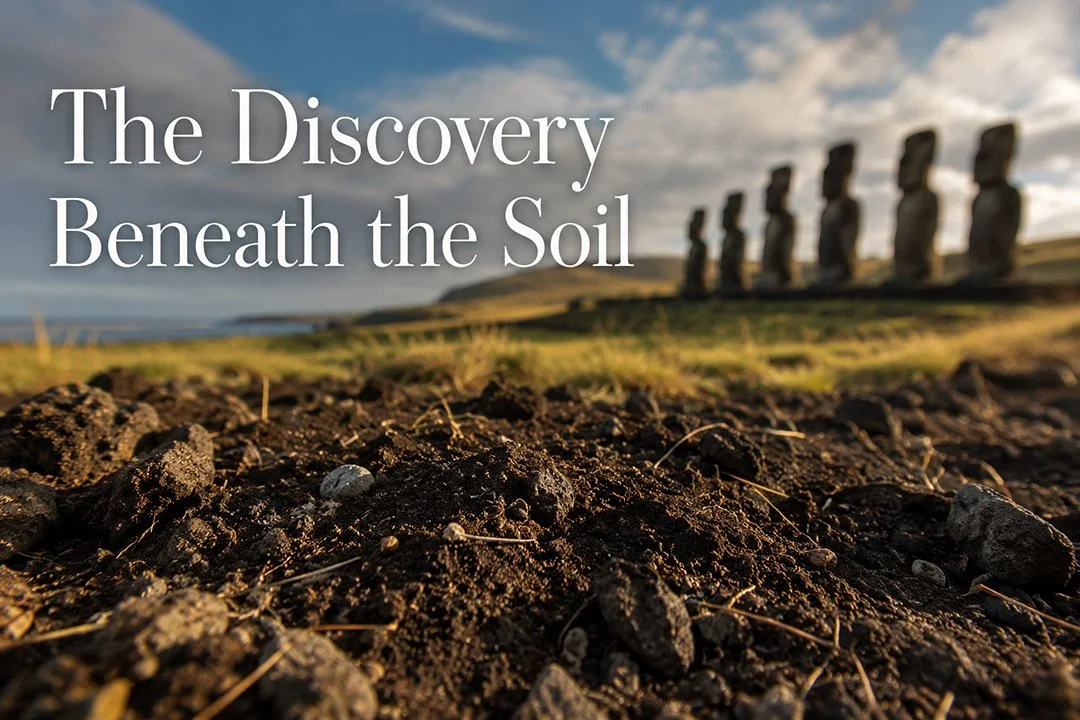
The Discovery Beneath The Soil
In 1964, a Canadian-led research team arrived on Rapa Nui as part of the Medical Expedition to Easter Island (METEI). Their objective was ambitious: to document an entire population and environment before the construction of an airport and increased contact with the outside world transformed the island.
The expedition examined nearly every resident.
It surveyed plants, animals, soils, waters, and health conditions.
Researchers divided the island into survey sectors and collected samples across the landscape.
At the time, no one knew that one of those samples would eventually contribute to the discovery of rapamycin.
That story interested me.
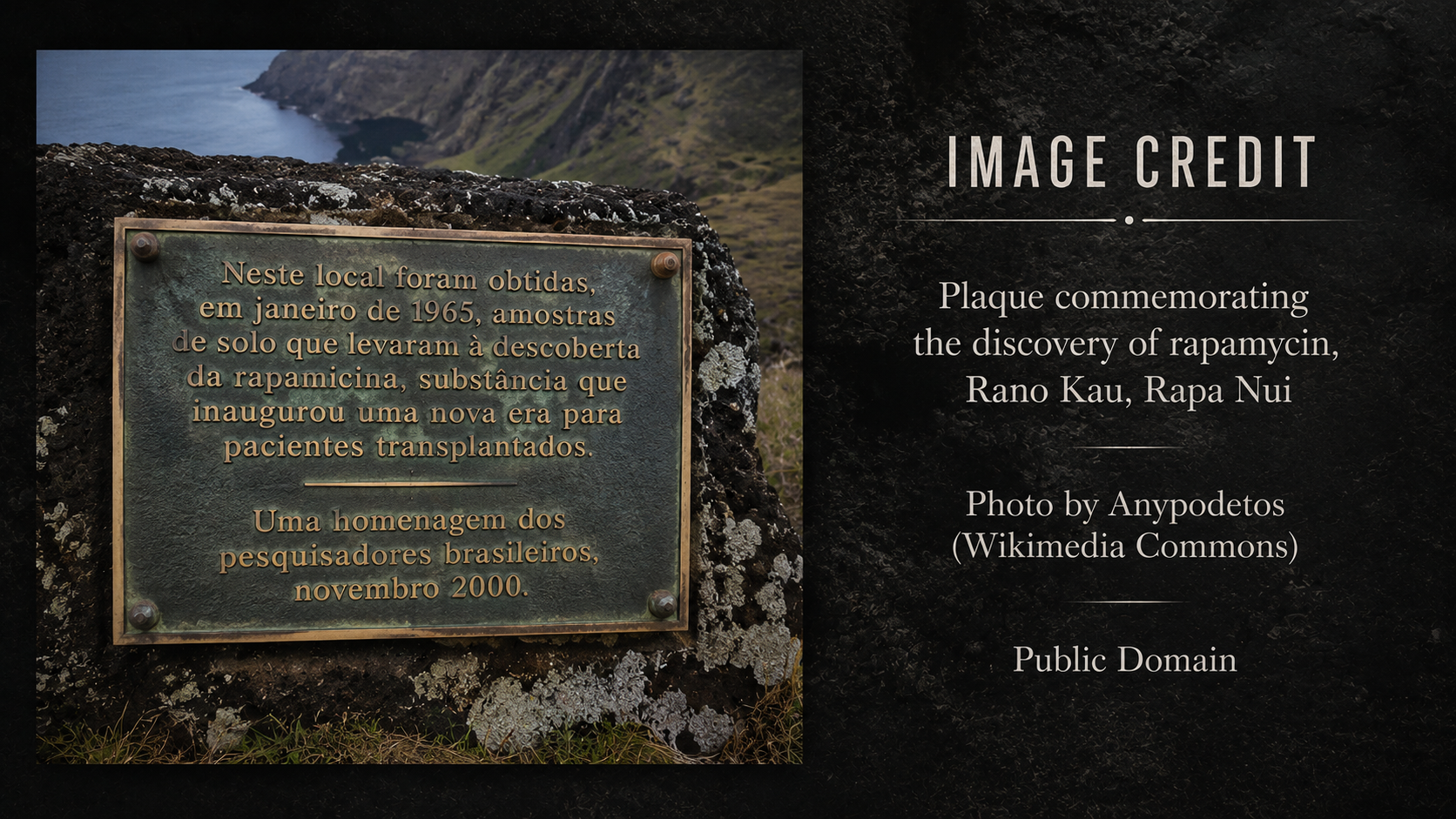
Plaque commemorating the discovery of rapamycin, Rano Kau, Rapa Nui
But another observation stayed with me even longer.
Throughout the documentary record of the expedition runs a recurring theme: change was coming.
The airport was being planned.
Political tensions were reshaping relations between Rapanui and Chile.
New forms of contact with the outside world were emerging.
The expedition was not simply studying a place.
It was attempting to record a threshold.
The researchers believed the island stood at a moment of transformation. Their goal was to understand the people, health, environment, and ecology of Rapa Nui before those changes unfolded.
In that sense, the expedition was documenting more than an island.
It was documenting a system in transition.
Decades later, one of the most important scientific outcomes associated with the expedition would emerge from a microorganism isolated from the island's soil.
One of those discoveries became rapamycin.
Yet the larger story remains equally compelling.
An island.
A community.
An environment.
A moment suspended between continuity and transformation.
The discovery of rapamycin emerged from that context.
Not in isolation from it.
The more I learn about Rapa Nui, the less interested I become in singular explanations.
Places contain multiple stories at once.
Some are visible.
Some remain beneath the surface.
And sometimes a handful of soil reveals far more than anyone expected.
“It is an urgent necessity to learn everything about them now before that happens…”
That statement appears repeatedly throughout the expedition record.
It raises a question that extends beyond rapamycin itself:
What was the expedition really trying to preserve?
A microorganism was discovered in the soil.
But perhaps the deeper story was the recognition that an entire way of life stood at a threshold.
And perhaps that story is still unfolding.
A microorganism was discovered in the soil. But perhaps the deeper story was not what was found. Perhaps it was what the expedition feared might be lost.
Related Reading:
Human Development and Institutional Systems: A Feedback Framework (Coming Soon)
Important discoveries often emerge when people are trying to understand an entire system rather than a single outcome.
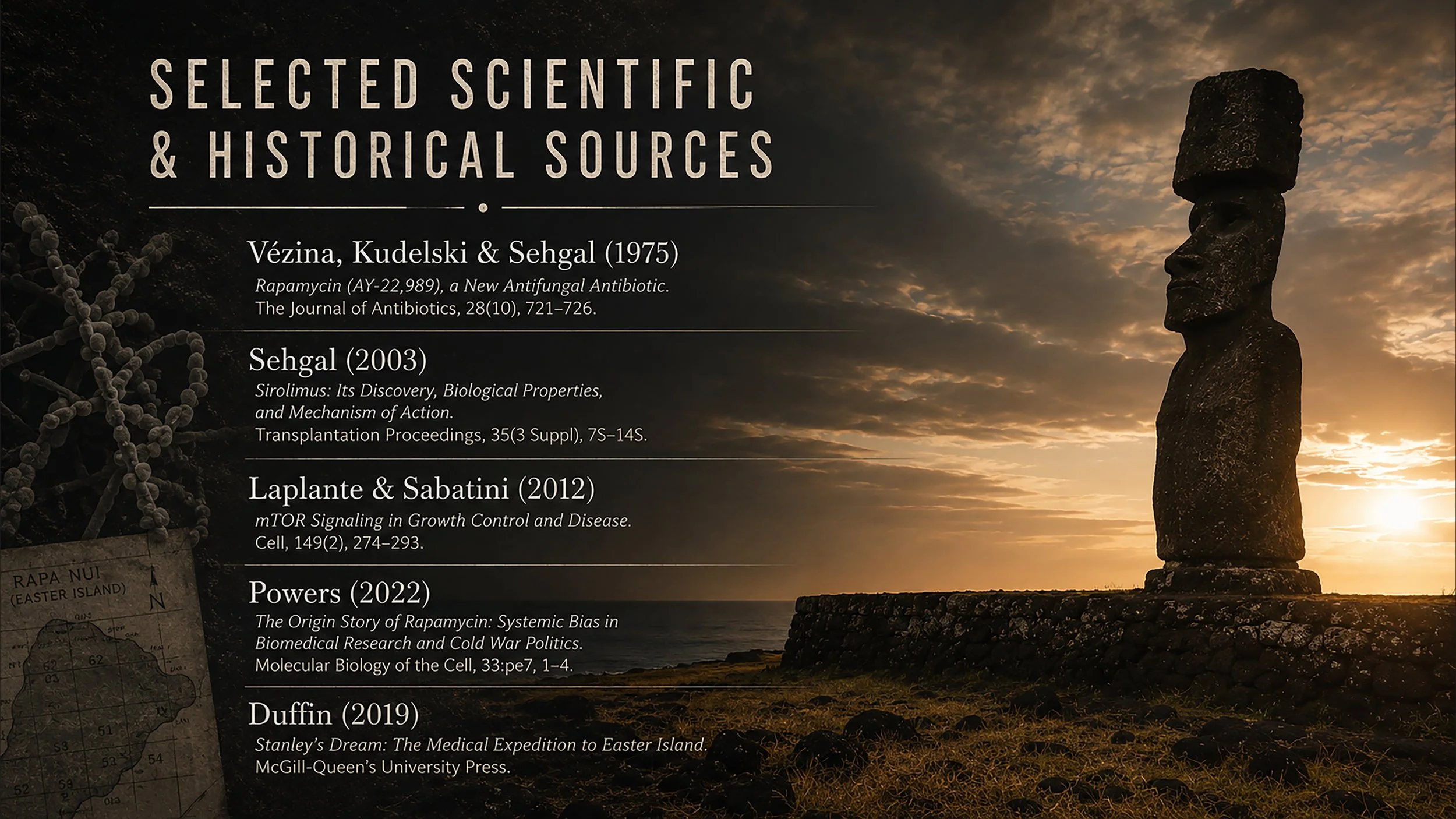
References
Duffin, J. (2019). Stanley's dream: The medical expedition to Easter Island. McGill-Queen's University Press.
Laplante, M., & Sabatini, D. M. (2012). mTOR signaling in growth control and disease. Cell, 149(2), 274–293. https://doi.org/10.1016/j.cell.2012.03.017
Powers, T. (2022). The origin story of rapamycin: Systemic bias in biomedical research and cold war politics. Molecular Biology of the Cell, 33(11), pe7. https://doi.org/10.1091/mbc.E22-08-0377
Sehgal, S. N. (2003). Sirolimus: Its discovery, biological properties, and mechanism of action. Transplantation Proceedings, 35(3 Suppl), 7S–14S. https://doi.org/10.1016/S0041-1345(03)00211-2
Vézina, C., Kudelski, A., & Sehgal, S. N. (1975). Rapamycin (AY-22,989), a new antifungal antibiotic. I. Taxonomy of the producing streptomycete and isolation of the active principle. The Journal of Antibiotics, 28(10), 721–726. https://doi.org/10.7164/antibiotics.28.721
