


Myth & Symbol
How humans organize meaning through narrative, image, ritual, and place.
Myth and symbol are not simply stories about the past.
They are among humanity's oldest systems for organizing experience, preserving knowledge, and communicating meaning across generations.
Long before ideas became formal theories or written scholarship, societies encoded observation, memory, identity, and relationships within stories, monuments, rituals, and symbolic landscapes.
Rather than asking whether myths are literally true, this research explores a different question:
What do symbolic systems reveal about how humans perceive, organize, and communicate experience?
Drawing on archaeology, anthropology, psychology, history, systems thinking, and direct field observation, this work examines myth and symbol as enduring languages through which cultures make sense of the world.
WHY MYTH & SYMBOL MATTER
Research Questions
This field explores questions such as:
How do symbolic systems preserve knowledge across generations?
Why do certain narrative structures appear across cultures?
How do monuments, landscapes, and ritual encode environmental observation?
How do symbols organize perception before concepts emerge?
What role does mythology play in identity formation and social cohesion?
How does lived experience become communicable through narrative and symbol?
How do myths continue to shape institutions, leadership, and collective memory today?
MYTH AS A LANGUAGE
Human experience rarely arrives as concepts.
Instead, human understanding often develops through a series of translations.
Encounter
↓
Perception
↓
Meaning
↓
Symbol
↓
Narrative
↓
Language
↓
Concept
↓
Knowledge
↓
Scholarship
Myth and symbol occupy some of the earliest stages in humanity's translation of experience into communicable knowledge. Rather than opposing knowledge, they represent one of humanity's oldest languages for organizing experience before it becomes formal explanation.

AREAS OF INVESTIGATION
-
Explore how recurring narrative structures, cosmological themes, and symbolic motifs appear across cultures. Rather than seeking common origins, this inquiry examines how different societies use myth to organize knowledge, identity, and relationships with the natural world.
-
Investigates how humans organize perception through symbols before ideas become formal concepts. This area draws on cognitive science, anthropology, psychology, and symbolic traditions to explore how images, metaphors, and symbolic systems shape human understanding.
-
Examines how personal and collective identities are organized through narrative. Stories do not simply describe experience—they structure memory, meaning, continuity, and social belonging across individuals, communities, and cultures.
-
Explores recurring symbolic patterns that appear across mythology, literature, ritual, and human experience. Rather than treating archetypes as fixed meanings, this research examines how they function as enduring structures for organizing perception, behavior, and cultural memory.
-
Investigates how rituals preserve collective memory, reinforce social identity, and transmit knowledge across generations. Ritual is examined as a cultural technology through which communities maintain continuity despite changing historical conditions.
-
Explores how landscapes become meaningful through ceremony, architecture, orientation, and cultural practice. This research examines how mountains, rivers, monuments, caves, and ceremonial spaces function as repositories of memory and environmental knowledge.
-
Examines how monumental architecture reflects relationships between people, place, celestial observation, and seasonal cycles. Drawing on archaeology and field research, this inquiry explores how monuments participate in preserving and communicating knowledge.
-
Investigates how traditional narratives preserve ecological observation, seasonal rhythms, navigation, agriculture, and relationships with the natural world. Myth is approached as one mechanism through which environmental knowledge is organized and transmitted.
-
Explores how lived experience becomes communicable knowledge through successive stages of perception, symbol, narrative, language, and scholarship. This area connects mythology with the broader interdisciplinary study of knowledge translation and human meaning-making.
Myth & Symbol Series
The papers in this series explore how symbolic systems organize memory, orient societies within the landscape, and preserve knowledge across generations.
Drawing on archaeology, anthropology, history, and field observation, they examine how knowledge becomes embedded in landscapes, material culture, and cultural practice—while distinguishing carefully between archaeological evidence, historical interpretation, and questions that remain open.
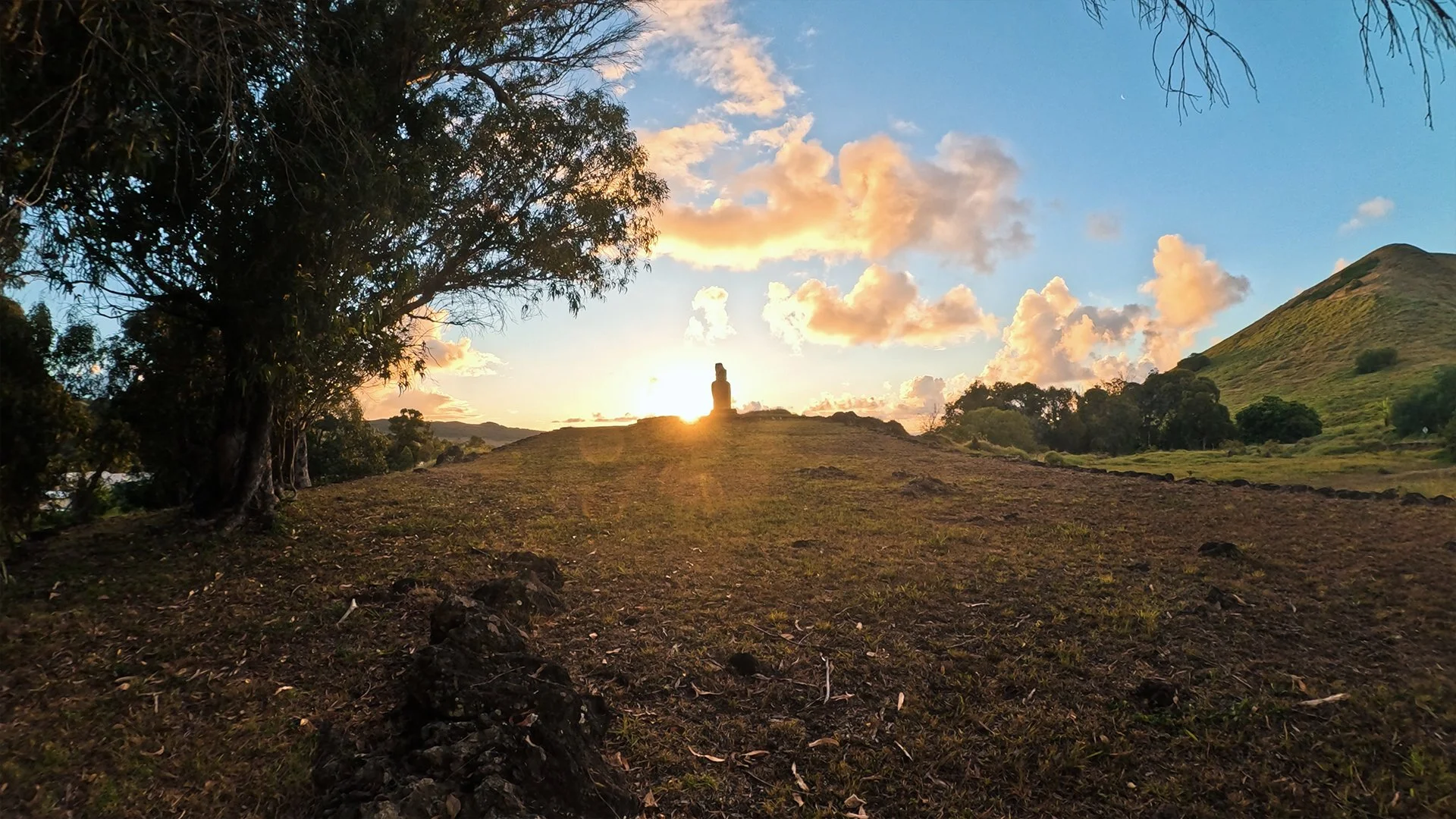
Paper 03 — Materializing Seasonal Knowledge: A Structural Reading of Ahu Huri a Urenga, Rapa Nui
An interdisciplinary study of one of Rapa Nui's most distinctive ceremonial monuments. Integrating archaeological evidence, archaeoastronomical research, ethnographic context, and original field observations, the paper examines how monumental architecture may have participated in preserving and communicating seasonal knowledge within a broader cultural landscape. Throughout, it distinguishes carefully between established archaeological evidence, published interpretation, and unresolved questions.
This paper contributes to a broader inquiry into how symbolic landscapes preserve knowledge, structure memory, and mediate relationships between people, place, and the natural world.
Rather than seeking definitive explanations, it explores how archaeological evidence, cultural tradition, and direct observation together illuminate the ways societies transform environmental observation into enduring systems of knowledge.
Essays exploring mythology, symbolic systems, archetypes, ritual, cultural memory, narrative, and human meaning-making.
For individuals and organizations navigating major transitions, symbolic narratives provide another lens for understanding change, identity, and meaning. Explore advisory services and guided inquiry informed by interdisciplinary research, systems thinking, and lived experience.
Related Writing
Essays and field notes exploring this domain in practice.