


SACRED PATH
An earlier developmental expression of the work on coherence, perception, sovereignty, and transition.
Sacred Path Mentorship is no longer offered as a membership program.
The work developed through Sacred Path remains part of the intellectual and practical foundation from which later work on Human Coherence, Perceptual Intelligence, the Nine Pillars, Sacred Pedagogy, and threshold states has continued to evolve.
This page is retained as part of that developmental history.
WHERE THIS WORK CONTINUES
The questions first explored through Sacred Path continue in several areas of my current work.
Human Coherence →
The broader inquiry into alignment across perception, meaning, action, and lived experience.
Perceptual Intelligence →
Research and practice concerned with how information is perceived, interpreted, and distinguished from assumption or distortion.
The Nine Pillars →
A developmental framework examining recurring dimensions of human coherence across the lifespan.
Sacred Pedagogy →
An emerging inquiry into how knowledge is developed and transmitted through lived, relational, symbolic, and experiential forms of learning.
Foundations →
Self-paced practices for those interested in working directly with aspects of coherence and perception.
Journal →
Current essays, field notes, and research inquiry.
A central premise of the work was that transition is not only a problem to be solved; it is also a condition in which a person must learn to remain oriented.
SACRED PATH MENTORSHIP
There are moments in life where the old self dissolves.
A relationship collapses.
A job ends.
A system fails you.
An identity falls apart.
Your intuition awakens.
Your boundaries break.
Your voice disappears — or begins to rise.
You enter a threshold.
And in that threshold, you do not need a course.
You need a field.
A space where:
• you can breathe again
• your nervous system can settle
• your intuition can strengthen
• your story can reorganize
• your sovereignty can return
• your next identity can emerge
This is the purpose of the Sacred Path Mentorship.
It is the living, evolving container where transformation becomes possible through coherence, presence, and structure.
WHAT SACRED PATH WAS
Sacred Path was developed as a pedagogical field rather than a conventional coaching program or content library.
The work emphasized learning through presence, reflection, lived experience, and structured inquiry rather than pressure or performance.
Its evolving curriculum brought together:
Archetypal & Symbolic Inquiry
Exploration of symbolic, perceptual, and structural dimensions of experience.
Threshold Work
Examining endings, beginnings, uncertainty, and periods of identity transition.
Emotional Coherence
Practices concerned with internal regulation, stability, and clarity.
Sovereignty
Work concerned with self-trust, boundaries, agency, and inner authority.
Perceptual Intelligence
Developing greater discrimination between perception, interpretation, pattern, and projection.
Living Curriculum
Meditations, essays, frameworks, diagrams, conversations, and practices developed in response to the questions emerging through the work.

From Mentorship to Sacred Pedagogy
One of the ideas that emerged through this work was that meaningful learning does not always occur through the transfer of information.
Learning can also occur through attention, reflection, dialogue, lived experience, symbolic interpretation, and the examination of experience as it unfolds.
This contributed to the later development of Sacred Pedagogy as an area of inquiry concerned with how knowledge and transformation can emerge through lived and relational forms of learning.
THE HUMAN AT THE THRESHOLD
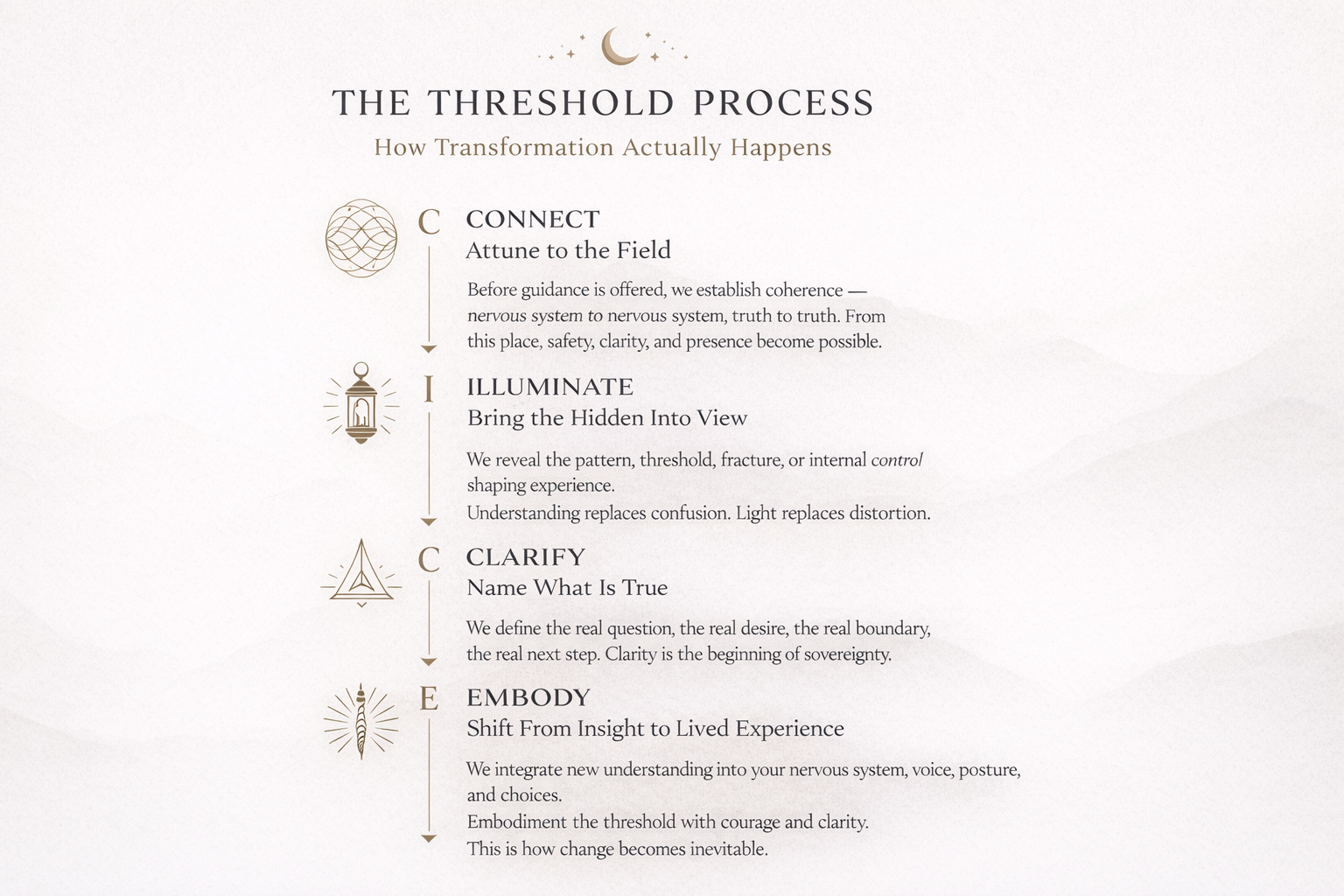
A recurring focus of Sacred Path was the human experience of transition: what happens when a familiar structure has ended but a new structure has not yet stabilized.
Relationship endings, professional transitions, institutional disruption, changes in identity, spiritual or perceptual experiences, and other forms of uncertainty can all create this condition.
The work explored how attention, emotional regulation, perception, narrative, boundaries, and meaning-making interact during these periods.
Five Recurring Areas of Development
Across the work, these five recurring areas became increasingly visible:
-
How to stabilize your field, stop collapsing, and hold clarity.
-
How to communicate truth, rebuild inner authority, and choose yourself.
-
How to sense accurately, read patterns, and understand symbolic information.
-
How to navigate transitions and rebuild yourself after collapse.
-
How to understand your life symbolically — the deeper story you are living.
These areas became part of the conceptual foundation from which later frameworks and research questions developed.
WHAT THIS WORK LOOKED LIKE IN PRACTICE
Sacred Path brought these questions into contact with lived situations rather than treating them only as abstract concepts. The work included:
• relationships, decisions, pressure, and life transitions
• emotional regulation during consequential moments
• distinguishing perception from interpretation and narrative
• identity changes and questions of direction
• structured reflection on lived experience
Sacred Path emerged from work with people navigating periods in which established structures of identity, relationship, direction, or meaning were changing.
These periods were understood as threshold states: conditions in which previous ways of organizing experience no longer function adequately, while what comes next has not yet fully formed.
The work explored a recurring question:
What helps a person remain coherent while the structures through which they previously understood themselves are changing?