

When Systems Drift
Governance, Institutional Trust, and Lived Experience
An Audiovisual Reflection on Governance and Institutional Experience
In many discussions about governance, institutions are evaluated primarily through operational performance. Systems are assessed according to whether services continue functioning, policies are implemented, and organizational objectives are maintained.
But operational continuity alone does not necessarily mean that a system remains relationally coherent to the people experiencing it.
This audiovisual essay emerged from that tension.
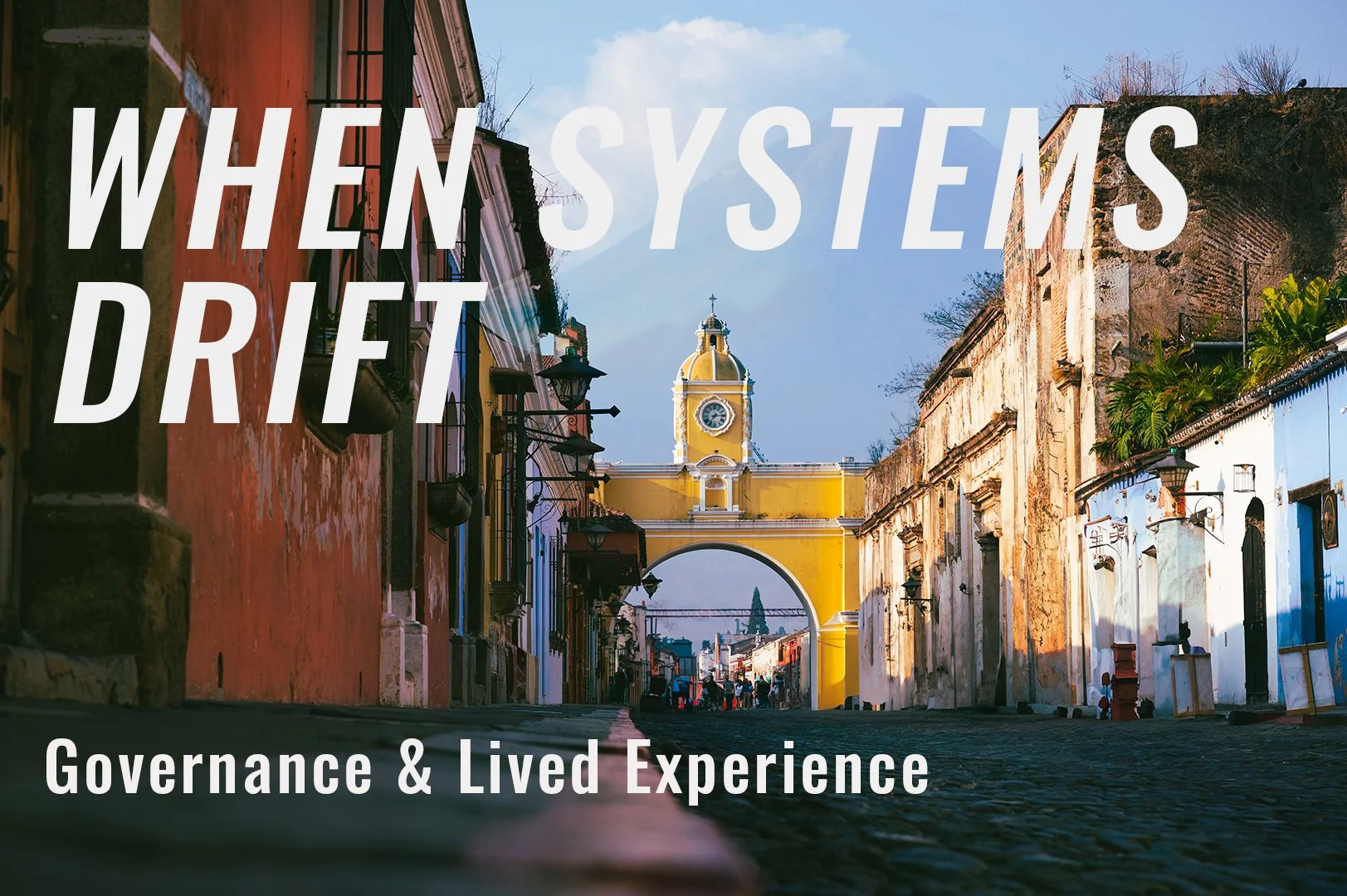
Governance & Lived Experience
Drawing on Street-Level Bureaucracy and Co-Creation theory, the project explores how institutions function not only through procedures and structures, but through interpretation, interaction, discretion, and trust. While systems may appear stable externally, lived experience within those systems can diverge significantly under conditions of sustained complexity or constraint.
Street-Level Bureaucracy, developed primarily through the work of Michael Lipsky, examines how frontline public service workers mediate policy implementation under real-world limitations such as time pressure, limited information, resource scarcity, and institutional complexity. Rather than applying policy mechanically, frontline actors interpret and adapt policy in practice, meaning that institutional outcomes are often shaped relationally through implementation itself.
Co-Creation theory emerged later as an attempt to rethink the relationship between institutions and the public. Rather than viewing citizens as passive recipients of services, co-creation frameworks emphasize participation, collaboration, and shared value creation. In this context, legitimacy becomes relational rather than purely procedural.
What became increasingly interesting to me while working through these theories was that both appear strongest when operational and relational dimensions remain aligned.
Street-Level Bureaucracy explains how systems maintain continuity under constraint through adaptation and discretion.
Co-Creation emphasizes relational legitimacy through trust and participation.
Yet under sustained pressure, both frameworks reveal forms of vulnerability.
Operational systems may continue functioning procedurally while relational trust gradually erodes. Institutions can remain structurally intact while lived experience within those systems becomes increasingly fragmented, constrained, or disconnected from formal institutional narratives.
This creates an important interdisciplinary question:
Can systems remain coherent if operational effectiveness persists while relational legitimacy declines?
Or, stated differently:
At what point does a system continue functioning structurally while beginning to fail experientially?
The audiovisual format became particularly important to this inquiry because governance is often discussed abstractly, detached from the environments in which institutional experience actually occurs.
This project instead approaches governance through movement, architecture, atmosphere, and sound.
Filmed in Antigua, Guatemala, the visual language of the piece focuses on:
repaired structures
layered architecture
constrained pathways
institutional textures
and spaces shaped through adaptation over time
The environment itself becomes part of the inquiry.
Rather than illustrating theory literally, the project attempts to create a perceptual atmosphere in which institutional continuity, strain, and relational experience can be felt simultaneously.
The sound layer was approached similarly.
Environmental audio was intentionally treated as part of the theoretical structure rather than background decoration. Corridors, footsteps, open courtyards, distant voices, bells, and reverberant public spaces were used to create an acoustic sense of institutional and relational space, allowing the presentation to remain accessible even without visual engagement.
In this sense, the project also intersects with broader questions within symbolic cognition, systems theory, and phenomenology:
how environments shape perception
how meaning emerges through interaction
and how institutional experience is often encountered relationally before it is interpreted conceptually
Ultimately, this work does not attempt to resolve the tension between operational systems and lived experience.
It simply suggests that governance may not be purely operational.
It is also relational.
And under conditions of sustained complexity, maintaining institutional coherence may depend not only on whether systems continue functioning, but on whether they continue functioning in ways that remain experientially legitimate to the people moving through them.
Related Concepts
Street-Level Bureaucracy
Co-Creation Theory
Systems Theory
Institutional Legitimacy
Governance Under Constraint
Symbolic Cognition
Perception and Environment
Operational vs Relational Systems
Related PDF
→ Structuring Discretion Under Complexity
Audiovisual Essay
