

Field Note: Rapa Nui — The Absence of Hyper-Vigilance
Field Note: Rapa Nui — The Absence of Hyper-Vigilance
Rapa Nui created something rare during this journey: space where the nervous system could finally stand down.
For two days the island closed under storms. Wind and rain pressed against the edges of the small town, and movement across the landscape slowed to almost nothing. It forced a pause.
In that pause something became clear.
For several years life had been lived under a background current of hyper-vigilance. Legal uncertainty, sudden moves, financial instability, and institutional conflict kept the mind scanning constantly for the next disruption. Even while traveling, that alertness remained just under the surface.
On Rapa Nui, it faded.
Not because rules disappeared. The island has rules everywhere — national park boundaries, archaeological protections, cultural protocols. But here the interaction with those rules was voluntary. I chose when to approach them, when to respect them, when to step back.
Choice changes everything.
When boundaries are chosen, they become part of the environment rather than something pressing against the nervous system.
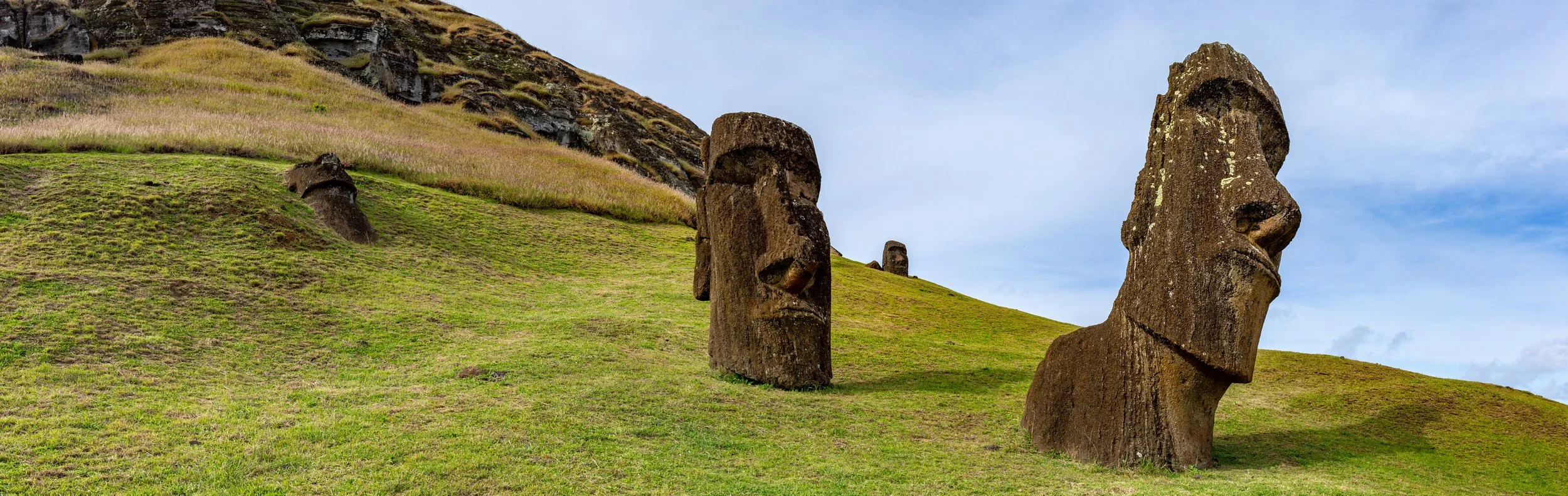
The island also carries its own quiet lesson about systems. The Moai stand as reminders of a civilization that organized immense collective effort around shared meaning. Whatever debates continue about their exact history, they represent a society that translated cosmology into structure — belief into stone.
Standing among them, the connection between myth, leadership, and systems becomes visible. Human societies always build structures around the stories they believe about themselves.
For me, the island marked a different kind of shift.
Movement had dominated the previous phase of life: travel, relocation, adaptation. Rapa Nui introduced something else — integration.
The storms forced stillness. Logistics were cleaned up. Rest replaced urgency. Reflection became possible without the background pressure of survival.
From that space a simple idea emerged: not permanence, but base camp.
Exploration remains important. Travel continues. But every expedition requires a stable place to return to — somewhere belongings remain, where the mind can rest, and where relationships remain accessible.
Base camp is not confinement. It is the platform that makes meaningful exploration possible.
As the flight leaves the island tomorrow, the most important thing to carry forward is not the landscape itself, but the condition that briefly appeared here: the absence of hyper-vigilance and the return of deliberate attention.
That is the real gift of the island.
The Moai Say: “We are here. We remember who we are.”
If this way of seeing holds, the work continues in The Field — where observation becomes orientation.
Rapa Nui’s Cognitive Effect: Why Small Islands Change How We Think
There is actually a known pattern in environmental psychology and human geography: very small, remote islands often produce a distinctive mental state in visitors. Researchers sometimes describe it as “bounded cognition” or “island containment.”
Rapa Nui is one of the clearest places on Earth where this effect can occur.
1. The Mind Changes When the World Has Edges
Most modern environments are open-ended systems:
cities expand outward
roads continue indefinitely
the horizon suggests more territory
My brain, maybe your brain, unconsciously treats these environments as infinite problem spaces.
Rapa Nui is the opposite.
The island is only ~24 km across.
The ocean surrounds it in every direction.
There is nowhere beyond the horizon except water.
The brain quickly recognizes this as a finite system.
That changes how attention works.
Instead of scanning for expansion, the mind begins to scan for meaning within boundaries.
2. Isolation Removes Cognitive Noise
Remote islands remove many layers of background stimulation:
traffic noise
dense population signals
constant novelty
institutional pressure
This reduces what psychologists call cognitive load.
When cognitive load drops, the brain often shifts from:
task mode → reflection mode
This is the same reason monasteries, retreat centers, and research stations are often located in isolated environments.
3. The Landscape Forces Pattern Recognition
Rapa Nui also has an unusual spatial structure.
Across the island you repeatedly see:
Moai platforms (ahu)
volcanic craters
stone quarries
ceremonial spaces
These features are spread across a small territory.
Visitors unconsciously begin mapping relationships between them.
The mind starts asking:
Why here?
Why aligned this way?
What social system created this?
The island itself becomes a systems puzzle. (I love a good puzzle)
That’s why it often triggers reflection about civilization, leadership, and cultural meaning.
4. The Ocean Changes Psychological Orientation
Being surrounded by open ocean creates a subtle psychological effect.
The horizon is always present, and it is always empty.
Research shows that large ocean horizons often induce:
humility
scale awareness
existential reflection
time perspective
People begin thinking in longer arcs.
This is sometimes called “the oceanic perspective.”
5. Storms Intensify the Effect
I experienced two stormy days which likely deepened this.
Storms temporarily reduce mobility and visibility.
When movement stops, attention naturally turns inward.
Anthropologists often note that weather-imposed stillness has historically been a major catalyst for storytelling, philosophy, and reflection.
6. Why Rapa Nui Feels Different from Other Islands
Many islands still have nearby landmasses.
Rapa Nui is different.
The nearest inhabited land is more than 2,000 km away.
It is one of the most isolated inhabited places on Earth.
Your brain senses that isolation, even if you don't consciously think about it.
That contributes to the psychological quiet.
7. Why Scholars and Writers Often Love Places Like This
Remote environments like Rapa Nui create conditions that support:
synthesis of ideas
reflection on systems
integration of experience
narrative thinking
Many writers and researchers deliberately seek places like this during periods of intellectual transition.
8. The Interesting Part
I arrived on Rapa Nui during a major life transition.
That means the island environment likely amplified a process that was already underway within me.
Instead of distraction, it gave me:
bounded space
quiet cognitive field
symbolic landscape
time pressure (I knew departure is coming)
All of which support integration of experience.
Where Next? Come back as we expand these ideas and the correlation between them all fully develop.
If this shifted how you see things—
this isn’t something you solve by thinking more.
It’s something you stabilize.
This can be learned.
But what it develops goes beyond technique.
It changes how you see, decide, and move.
