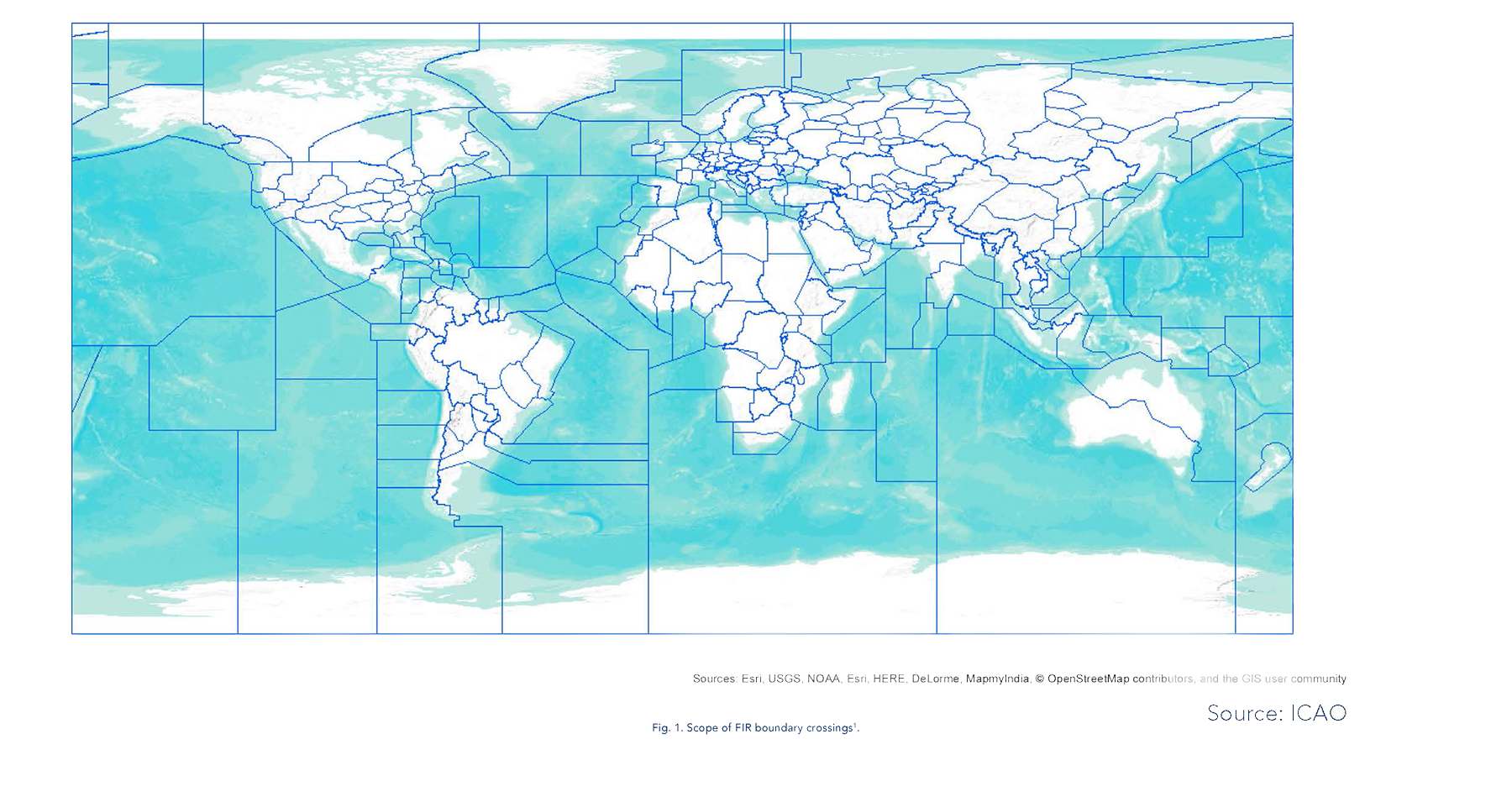
Best Practice Guide to Crossing Flight Information Region Boundaries
Operational Harmonization, Flight Planning, and Seamless Airspace
Published June 2015 | Civil Air Navigation Services Organisation
An international best-practice guide examining the operational, procedural, and technological conditions required for aircraft to transition safely and efficiently between Flight Information Regions. Developed through the CANSO Flight Information Region Boundary Crossing Task Force, the guide addresses flight-planning quality, surveillance transitions, automation, regional coordination, and the harmonization of air navigation services.
Keywords: air traffic management; FIR boundaries; seamless airspace; operational harmonization; flight planning; surveillance; international aviation; knowledge translation
This publication was produced by the Civil Air Navigation Services Organisation through its Flight Information Region Boundary Crossing Task Force. Greg C. Dansereau participated as NAV CANADA’s operational expert and organizational representative, working alongside specialists from the FAA, Airservices Australia, Airports Authority of India, Thales, and other international aviation organizations. The published guide acknowledges his contribution by name.
The guide examines the institutional and operational challenges that arise when aircraft cross between Flight Information Regions governed by different procedures, technologies, separation standards, and communication systems. It focuses particularly on two high-priority areas: the quality and transfer of flight-plan information, and the transition of aircraft between surveillance and non-surveillance environments. Its recommendations are intended to improve safety, interoperability, operational efficiency, and the continuity of service provided across national and regional boundaries.
At a broader level, the publication illustrates how operational knowledge is translated into international guidance. Experience from air navigation service providers was gathered, compared, and converted into shared recommendations aligned with ICAO standards and global aviation practices. The work therefore represents not only an aviation contribution, but an early example of a continuing research interest in how knowledge moves across organizational, professional, and institutional boundaries.
This publication sits within a broader body of work concerned with operational governance, institutional coordination, knowledge translation, and decision-making in complex systems. It demonstrates how safety-critical organizations can improve outcomes when technical expertise, collaborative governance, and shared standards are brought together across jurisdictions.
Related: Structuring Discretion Under Complexity
Skills Demonstrated: Internaional Collaboration; Governance; Operational Harmonization; Flight Planning; Stakeholder Coordination; Knowledge Translation; Technical Writing
Core Essays (Archived Editions)
Core Essays represent stabilized conceptual foundations within this body of work.
They are not revised retroactively except for formal version updates. Iteration occurs through expansion, not replacement.
Framework Documents
Framework documents present structured models, diagrams, and applied architectures that underpin the broader research program.
(Additional framework documents will be added here as they are formalized.)
Versioning and Citation
Versioning Policy
All documents in this archive are:
• Date-stamped
• Versioned
• Maintained for continuity
When revisions occur, the version number is updated. Earlier versions may be archived where relevant for citation integrity.
Citation
When citing materials from this archive, please reference the version number and publication date as indicated in the document.