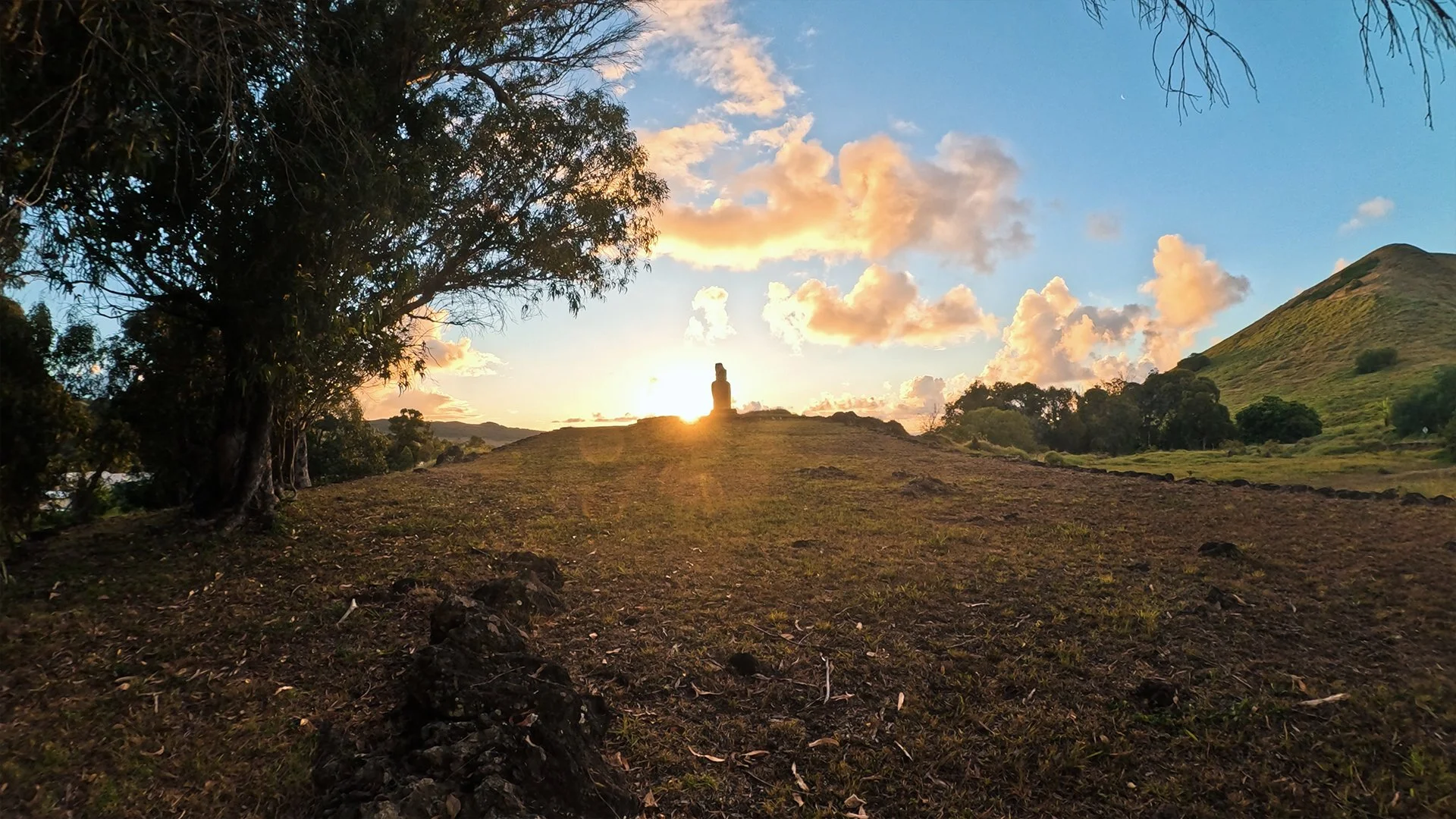
Materializing Seasonal Knowledge: A Structural Reading of Ahu Huri a Urenga, Rapa Nui
Myth & Symbol Research Paper No. 3
Research ID: MS-2026-003 | First Edition | 2026
An interdisciplinary study of Ahu Huri a Urenga on Rapa Nui that integrates archaeology, archaeoastronomy, ethnographic context, and original field observation. The paper examines how seasonal knowledge may have become materially embedded within ceremonial landscapes while distinguishing carefully between archaeological evidence, published interpretation, and unresolved questions.
Keywords: Rapa Nui; Ahu Huri a Urenga; archaeology; archaeoastronomy; ethnoastronomy; Polynesian astronomy; Matariki; seasonal knowledge; knowledge systems; ceremonial architecture; cultural landscapes; monumentality; field observation; Myth & Symbol
Ahu Huri a Urenga is one of Rapa Nui's most distinctive ceremonial monuments. Situated inland on an elevated ridge, its unusual architectural configuration, apparent astronomical orientation, and complex mortuary landscape have attracted archaeological attention for more than fifty years. Yet despite decades of investigation, many of its defining characteristics remain open to interpretation.
Drawing together William Mulloy's excavation reports, subsequent archaeoastronomical research, the 2010 Explorer's Club FLAG Expedition findings, and original field observations recorded during documentary fieldwork on Rapa Nui, this paper asks a broader question than whether the monument marks a particular celestial event. Instead, it explores how environmental observation may have become embedded within architecture, landscape, and cultural practice as a durable system of seasonal knowledge.
Rather than advancing a single explanatory model, the paper distinguishes carefully between archaeological evidence, published interpretation, and informed speculation. It evaluates multiple lines of evidence relating to architecture, astronomical observation, mortuary practice, ethnographic tradition, and ceremonial landscapes while remaining attentive to the limits of the archaeological record.
Particular attention is given to the relationship between seasonal knowledge and social coordination within broader Polynesian traditions. Rather than treating celestial observation as symbolic in isolation, the paper considers how astronomical knowledge may have informed navigation, ritual, fishing, planting, and other forms of communal organization. Within this perspective, Ahu Huri a Urenga is examined not as an isolated astronomical monument but as part of a wider cultural landscape through which environmental knowledge may have been preserved and communicated across generations.
More broadly, this research contributes to an ongoing inquiry into how societies materialize knowledge through landscapes, monuments, and symbolic systems. The paper considers how architecture can function not only as physical construction but also as a medium through which memory, perception, and ecological understanding become durable across time.
As part of the Myth & Symbol Research Series, this publication explores the intersection of archaeology, history, anthropology, and field observation to better understand how symbolic landscapes organize human relationships with place, time, and collective memory.
Related
Core Essays (Archived Editions)
Core Essays represent stabilized conceptual foundations within this body of work.
They are not revised retroactively except for formal version updates. Iteration occurs through expansion, not replacement.
Framework Documents
Framework documents present structured models, diagrams, and applied architectures that underpin the broader research program.
(Additional framework documents will be added here as they are formalized.)
Versioning and Citation
Versioning Policy
All documents in this archive are:
• Date-stamped
• Versioned
• Maintained for continuity
When revisions occur, the version number is updated. Earlier versions may be archived where relevant for citation integrity.
Citation
When citing materials from this archive, please reference the version number and publication date as indicated in the document.